
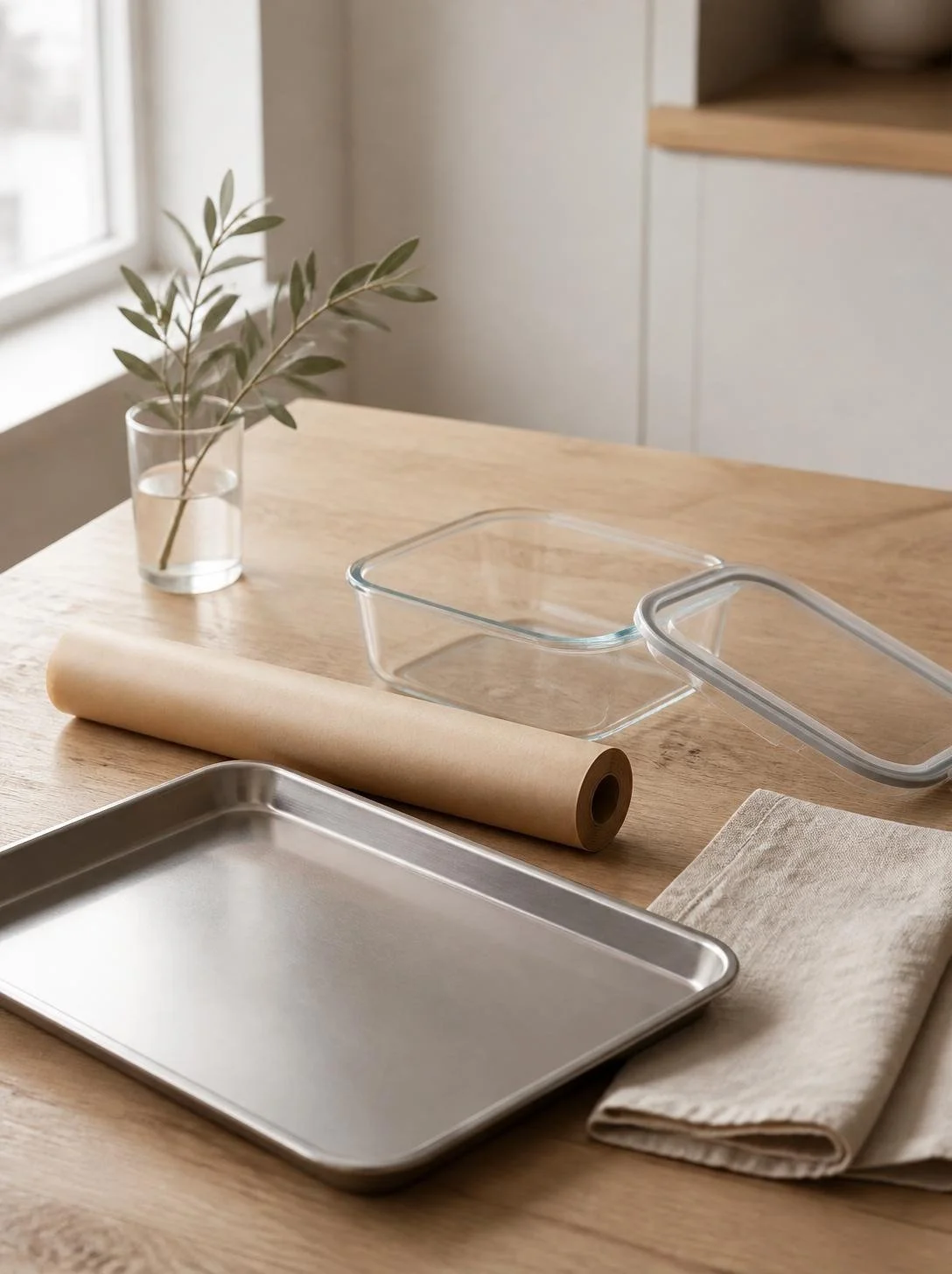
If you’ve ever stood in front of your kitchen cabinets wondering where to begin with a more intentional kitchen, you’re not alone. There is a lot of advice out there, and much of it arrives with a side of alarm.
This guide is the calmer version. Below are six non-toxic kitchen swaps worth considering, along with what each product is made of, what to know before you buy, and where it fits. You don’t need to replace everything, and you don’t need to do it all at once.
Start Gradually
Replace things as they wear out
The easiest way to build a more intentional kitchen is slowly. Keep using what you have. When a pan wears out, a container cracks, or you’re running low on something you buy regularly, that’s your moment to choose a replacement you feel good about. Nothing in your kitchen right now needs to be treated like an emergency.
What “non-toxic” does and doesn’t mean on a label
You’ll see “non-toxic” in product titles everywhere, including some of the products below. In this guide, that word is treated as the seller’s description, not as proof of anything. Instead, the focus is on being specific: what the main material is, what else is part of the product, and who is making each claim. Where a detail comes from the brand or seller rather than independent confirmation, it’s described that way.
Note: “Non-toxic” is not a universal certification or a guarantee that a product is safe. What the term means can vary from one seller to the next, and materials and formulations can change, so always review the manufacturer’s current product information and care instructions before purchasing.
A Quick Guide to the Materials
Here are plain-language notes on the materials you’ll see in the swaps below. The product details come after.
Stainless steel
Stainless steel is a metal alloy, and it’s a popular choice for cookware and bakeware because it’s sturdy and typically doesn’t have a coating applied the way nonstick pans do. Not every stainless steel product is entirely stainless steel, though. Lids, handles, and bases can be made of other materials, and the specific grade isn’t always listed, so it’s worth reading the details.
Glass
Glass is a familiar material for food storage. It’s non-porous, easy to see through, and tends to resist stains and lingering smells. The trade-offs are weight and breakability. Glass containers also often have lids made of something else, which is worth checking.
Silicone
Silicone is a flexible, rubber-like manufactured material. It’s a different material from conventional plastic, but it isn’t a natural one either, and formulations vary by brand. The most useful thing you can do is read what the brand says it’s made from and follow its care instructions.
Paper
Parchment paper is paper with a nonstick coating, often silicone. “Unbleached” means the paper hasn’t been whitened, which is why it looks brown.
If you’re also thinking about cutting boards, utensils, towels, and mixing bowls, those are covered in our guide to five everyday kitchen essentials.
The Six Swaps
Each swap below follows the same pattern: what it replaces, what it’s made of, and what’s worth knowing before you buy.
For Cooking: Cuisinart Chef’s Classic Stainless Steel 11-Piece Cookware Set
View the Cuisinart Chef’s Classic set on Amazon →
What it replaces: Coated nonstick cookware.
What it’s made of: This set (model 77-11G) has stainless steel cooking surfaces, exteriors, and handles, with tempered glass lids. The base has an aluminum core that’s enclosed within the stainless steel. There’s no nonstick coating on the cooking surface.
Good to know: Because the base includes aluminum and the lids are glass, this isn’t an all-stainless set, and that’s worth keeping in mind if you’re choosing materials carefully. Stainless steel also behaves differently from nonstick, so expect a small learning curve with food sticking. Following the manufacturer’s care and cooking guidance helps.
For Baking: Wildone Stainless Steel Baking Sheets, Set of 3
View the Wildone baking sheets on Amazon →
What it replaces: Coated or nonstick baking sheets.
What it’s made of: Stainless steel. The seller describes the sheets as uncoated.
Good to know: The uncoated description comes from the seller, so check the current product listing and care instructions before you buy. This is a set of three baking sheets and doesn’t include cooling racks.
For Baking: If You Care Unbleached Parchment Baking Paper
View the If You Care parchment paper on Amazon →
What it replaces: Bleached parchment paper or foil for lining pans, if that’s what you use now.
What it’s made of: Unbleached paper with a silicone coating, sold as a 70-square-foot roll. If You Care describes the paper as FSC-certified and totally chlorine-free.
Good to know: This isn’t a coating-free product. The coating is what makes parchment nonstick. What sets this one apart is that the paper is unbleached, and the certification and chlorine-free statements are the brand’s own descriptions. It pairs naturally with the baking sheets above.
For Food Storage: Rubbermaid Brilliance Glass Food Storage Set
View the Rubbermaid Brilliance Glass set on Amazon →
What it replaces: Plastic food storage containers.
What it’s made of: A set of nine containers with lids (18 pieces total). The containers are glass, and the lids are plastic. Rubbermaid lists the lids as plastic, and the listing describes the set as BPA-free and leak-proof.
Good to know: This is a lower-plastic option, not a plastic-free one. The lids are the part that stays plastic. As with any glass, it’s heavier than plastic and can break.
For Food Storage: View Silicone Food Storage Bags on Amazon →
What it replaces: Single-use plastic storage bags.
What it’s made of: Silicone. Stasher describes it as platinum food-grade silicone and says it’s free of BPA, BPS, lead, latex, and phthalates.
Good to know: Those statements come from Stasher. Silicone is a manufactured material, so these are best thought of as a reusable alternative to single-use bags rather than a natural-material one. The bag sizes in a 4-pack can vary, so check the listing for what’s included, and follow Stasher’s care instructions.
For Cleaning: Blueland Dishwasher Tablets, Free & Clear, 60 Count
View the Blueland tablets on Amazon →
What it replaces: Conventional dishwasher pods or tablets.
What the brand says: Blueland describes the tablets as plastic-free, without the PVA film used on many dishwasher pods. That description applies to the tablets themselves. This guide doesn’t make claims about the packaging or the ingredients.
Good to know: This is a consumable you’ll buy again, so the swap is about format and personal preference rather than a safety upgrade. Follow the label directions.
Where to Start
If six swaps feels like a lot, take the pressure off. Any of them is a perfectly good first step. Three questions can help you decide:
What do I use every day? Start where you’ll notice the difference most often.
What is already worn out, scratched, cracked, or running low? That’s a natural time to replace something.
What fits my budget right now? A roll of parchment paper or a box of dishwasher tablets is a smaller step than a full cookware set, and larger purchases can wait until an item wears out.
One swap this month is progress. You can come back to the rest whenever it makes sense.
What You Don’t Need to Replace
Your existing pans, containers, and tools aren’t an emergency. If they’re in good condition and you’re happy with them, keep using them. A kitchen built slowly, with materials you understand, will serve you better than one replaced all at once out of worry.
Quick Reference
Cuisinart Chef’s Classic 11-piece cookware set
Replaces: Coated cookware
Material: Stainless steel surfaces and handles; glass lids; aluminum core in the base
Good to know: Not all stainless; stainless has a learning curve with sticking
Wildone stainless baking sheets, set of 3
Replaces: Coated baking sheets
Material: Stainless steel; the seller describes it as uncoated
Good to know: Seller’s description; no cooling racks included
If You Care parchment paper
Replaces: Bleached parchment or foil
Material: Unbleached paper with a silicone coating
Good to know: Coated; the FSC and chlorine-free statements are the brand’s
Rubbermaid Brilliance Glass set
Replaces: Plastic containers
Material: Glass containers; plastic lids
Good to know: Lower-plastic, not plastic-free
Stasher 4-pack
Replaces: Single-use bags
Material: Silicone, which Stasher describes as platinum food-grade
Good to know: Manufactured material; check which bags are in the pack
Blueland tablets, Free & Clear, 60 count
Replaces: Conventional dishwasher pods
Material: Tablets Blueland describes as plastic-free, without PVA film
Good to know: A consumable; no packaging or ingredient claims here
Frequently Asked Questions
What should I check on a product page before buying?
Look at what every part is made of, including lids, seals, handles, and bases, not just the main material. Notice who is making each claim: the brand, the seller, or an independent source. Check the care instructions, and pay attention to what the listing doesn’t say. A missing detail is useful information too.
Does “BPA-free” mean plastic-free?
No. BPA stands for bisphenol A, a specific chemical. “BPA-free” means a product is described as being made without that one chemical. It doesn’t tell you whether the product is plastic or what it’s made of instead. If avoiding plastic matters to you, look at the materials list rather than that label.
Final Thoughts
A more intentional kitchen isn’t built in a weekend, and it doesn’t need to be. Choose the swaps that make sense for how you cook and live, read the details, and replace things as they wear out. These non-toxic kitchen swaps are meant as helpful starting points, not a checklist you have to finish.
If you’d like more ideas, five more kitchen essentials worth swapping are waiting in our earlier guide.
Disclosure: This article contains affiliate links. If you purchase through one of these links, I may earn a small commission at no additional cost to you. I only recommend products I believe are worth considering.
